Зміст публікації
EXECUTIVE SUMMARY
On 12 June 2026, the Ukraine–European Union Intergovernmental Conference took place in Brussels, following which the EU adopted its Common Position on the opening of Cluster 1, Fundamentals. The document sets out a list of reforms and concrete benchmarks that Ukraine must achieve which include depoliticisation of the position of the Prosecutor General.
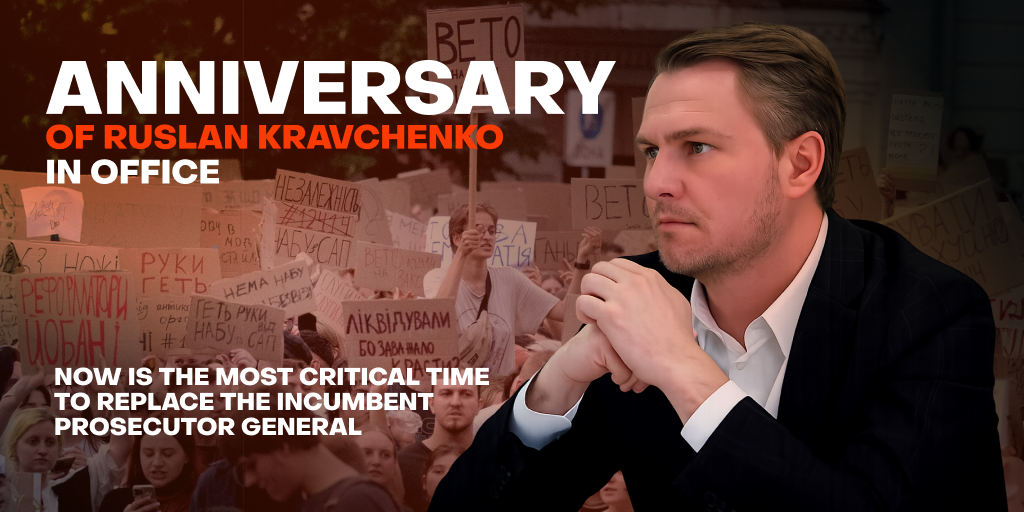
This is the most relevant time to replace the current Prosecutor General, Ruslan Kravchenko, in a meritocratic way, who clearly goes beyond the authority and whose actions do not correspond to the status of the highest procedural supervision.
Ruslan Kravchenko was appointed as Prosecutor General in June 2025. Such an appointment is a largely political rather than merit-based process, as he is appointed by the President without any competitive procedures, with the consent of the Verkhovna Rada, which holds a parliamentary majority of the President’s party “Servant of the People”. Moreover, he previously was part of the presidential administrative apparatus in the regions.
The short-term serving as the Prosecutor General once again made it clear that law enforcement agencies must be independent of any political influence and must not serve as instruments of pressure or intimidation against citizens and anti-corruption agencies. Political escalation and democratic backsliding occurred almost immediately after Ruslan Kravchenko’s appointment as Prosecutor General, as outlined below.
1. Intensified pressure on the anti-corruption infrastructure carried out under the procedural control of the Prosecutor General
On June 22, 2025, NABU and SAPO formally notified the Deputy Prime Minister of Ukraine and close friend of the President, Oleksiy Chernyshov, of suspicions of abuse of office and receiving illicit benefits. In addition, NABU already carried out operation Midas (investigation on the activities of a criminal organization in the energy sector under the leadership of a close associate of the President, Timur Mindych). Following this, in July 2025, intensified pressure on the anti-corruption infrastructure began, carried out under the procedural control of the Prosecutor General and at the direction of the Office of the President.
This is evidenced by a series of events:
- Over 70 simultaneous searches conducted by NABU, the arrest of NABU detectives, namely Ruslan Magamedrasulov and Viktor Gusarov.
- In response to investigative actions against individuals close to President Zelenskyy, the Prosecutor General personally signed notices of suspicion against NABU detectives without sufficient evidence. The cases concerned private correspondence from 2015, a traffic accident in 2021, and most importantly – one of the suspicions was announced against Ruslan Magamedrasulov, a key detective in the case against Zelenskyy’s associate, Timur Mindich.
- Subsequently, there was an attempt to dismantle the NABU and SAPO, by making them accountable to the Prosecutor General, which would have undermined the independence of these institutions. Media indicated that draft Law 12414, aimed at this, was developed within the Prosecutor General’s Office.
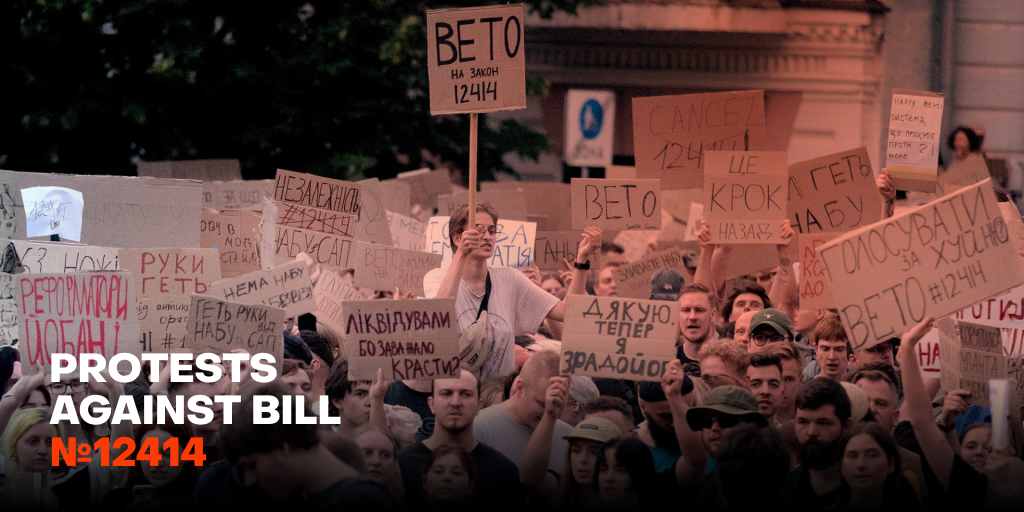
- Although the attempt to fully dismantle the anti-corruption infrastructure was unsuccessful, many harmful amendments were nevertheless adopted, including the abolition of competitive selection procedures in the Prosecutor`s system. Appointing prosecutors through a discretionary, manual process does not contribute to the sustainability or development of the institution, as it increases the risk of an appointment of non-integrity personnel.
2. The Emergence of Political Prisoners
The cases of NABU detectives Ruslan Mahamedrasulov and Viktor Husarov raise serious concerns about the use of criminal proceedings against anti-corruption officials for political purposes.
The case of Ruslan Mahamedrasulov is a striking example of politically motivated persecution. The NABU detective and his father were arrested and detained by the Security Service of Ukraine and State Bureau of Investigations for nearly five months. There are serious concerns that the case was fully fabricated, as the detective had been involved in uncovering an embezzlement scheme at Energoatom involving a close associate of the President (“Mindychgate”). The notice of suspicion was personally signed by the Prosecutor General despite the absence of sufficient evidence of a criminal offence and, consequently, the lack of legal grounds for detention. The detective was released in December 2025, just after Andriy Yermak had been dismissed.
See details on Ruslan Mahamedrasulov case – here.
The case of Detective Viktor Husarov further illustrates these concerns. On 4 June 2026, the prosecution formally withdrew all charges against him, effectively acknowledging the weakness of its case. This development ultimately vindicated civil society’s position that the criminal proceedings had been unjustified, as the prosecution chose to abandon the case rather than proceed with a substantive examination of the allegations before the court.
3. Questionable appointments and russian ties
A dishonest Prosecutor General inevitably begins appointing individuals with questionable reputations to key positions, making the issue of merit-based selection no longer merely a matter of depoliticizing the Ukrainian prosecution service, but the only effective safeguard against arbitrary personnel policies.
Ruslan Kravchenko previously failed the SAP Prosecutor competition and was banned from the 2023 NABU Director competition due to reputational issues. Nevertheless, the President identified no concerns regarding his integrity and appointed him as Prosecutor General. This background has led to nepotism in personnel appointments, with integrity no longer a priority:
- The appointment of Maria Vdovychenko, Viktor Lohachov, and Maksym Krym as his deputies, who have multiple persistent family ties with citizens of the russian federation and who are personally loyal to Ruslan Kravchenko.
- MEZHA has identified a number of controversial appointments to key positions within the Office of the Prosecutor General. These include Ashot Gevorkyan, appointed Head of the Department for Supervision of Organized Crime Bodies and Investment Protection, whose rapid promotion and family assets raise integrity concerns; Danyil Trunin, appointed Head of the Department for Supervision of the State Bureau of Investigations, whose family acquired high-value real estate under circumstances warranting scrutiny.
- The most controversial of Kravchenko’s appointees is Aidyn Khudiiev, a long-time subordinate dating back to their service in the military prosecution system. Kravchenko appointed Khudiiev to head the unit responsible for supporting the Prosecutor General’s powers in criminal proceedings – a position that, according to MEZHA’s findings, has been used to pursue cases against political opponents and exert pressure on businesses. MEZHA’s investigations further indicate that Khudiiev accumulated multimillion undeclared assets during his time in office.
- During his first year in office, Kravchenko appointed 18 out of 25 regional prosecutors, including members of his own team. A number of these appointees were later linked to serious integrity concerns, including questions regarding unexplained wealth and the legality of acquired assets.
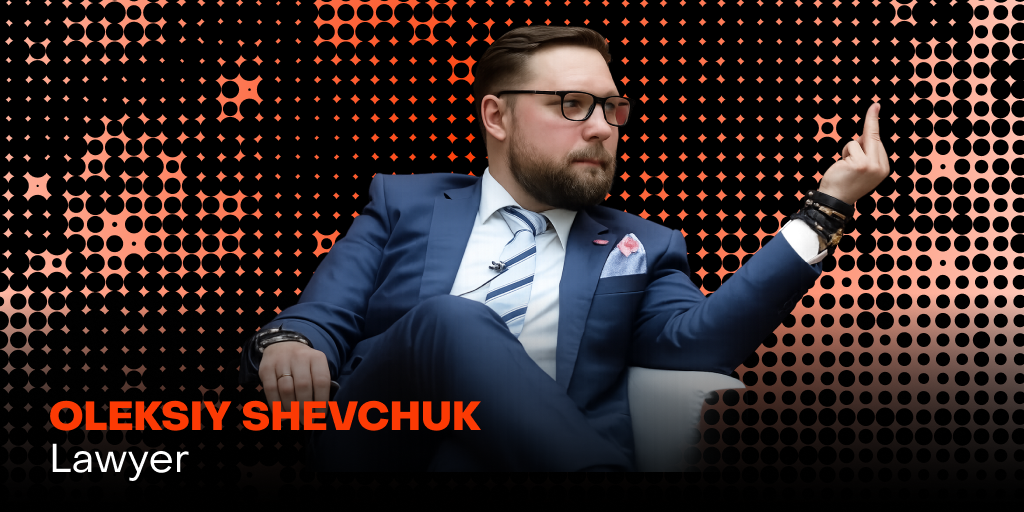
- The appointment of Oleksii Shevchuk to the SAPO competition commission raises concerns, as he was previously found to lack integrity during a competition for a position on the High Council of Justice. Furthermore, in May 2026, his right to practise law was suspended for a third time by a disciplinary body of the legal profession.
Moreover, we detected Russian ties in Kravchenko’s family. Ruslan Kravchenko’s father, Andrii Kravchenko, obtained a Russian passport in June 2023. This occurred one year after the occupation of Sievierodonetsk, where he resided. After obtaining the Russian passport, Andrii Kravchenko crossed automobile checkpoints between the russian federation and the occupied Luhansk region at least four times between June and September 2023, using his Dacia Logan vehicle.
4. Oleksiy Shevchuk case as a new attempt to undermine the work of SAPO
On 23 December 2025, Prosecutor General Kravchenko delegated Oleksii Shevchuk, whose professional reputation and integrity are questionable, to the SAPO competition commission (he is the subject of journalistic investigations, has faced disciplinary action as an attorney, has supported unconstitutional laws of a dictator, Viktor Yanukovych, and has worked for pro-Russian individuals). Over 60 civil society organizations and media outlets called to revoke the delegation, but as of early February, it had not been reversed.
Considering Kravchenko’s previous background of proactive opposition to the SAPO and NABU, as well as his inadequate response to criticism, his appointment of Shevchuk to the commission represents a deliberate attempt to sabotage the competition, from which he will not back down.
Moreover, the Prosecutor General is manipulating with the false information in his latest statement by claiming that he cannot exclude Oleksii Shevchuk from the Competitive Commission responsible for organizing and conducting the selection process for vacant leadership positions at SAPO.
See details on Oleksiy Shevchuk case – here.
5. Abuses of procedural powers
During the review of information from the Unified State Register of Court Decisions, we identified that prosecutors from the Division for Ensuring the Exercise of the Prosecutor General’s Powers in Criminal Proceedings within the Department of Organizational and Control Activities of the Prosecutor General’s Office (directly subordinate to the Prosecutor General) independently carrying out criminal procedural measures. In particular, this is evidenced by rulings of investigating judges of the Pecherskyi District Court of Kyiv in cases №757/10173/26-к, №757/10174/26-к, №757/10175/26-к, №757/14089/26-к, and other similar cases.
These cases have a number of similar features: information was entered into the Unified Register of Pre-Trial Investigations by prosecutors themselves, while cases are political or financial in nature.
In 2019 the prosecution system underwent fundamental changes, removing investigative powers from prosecutors, since the practice of combining investigative functions with procedural oversight does not comply with justice standards. Nevertheless, prosecutors independently initiated cases that appear to have political character, including cases involving the Anti-Corruption Action Centre, Oleksandr Kudrytskyi, the former head of Ukrenergo, etc), as well as cases that are likely to involve financial interests (for example, those concerning crypto exchanges).
The unit is headed by Aidyn Khudiiev, a long-time associate of Ruslan Kravchenko, whom we mentioned above.
6. The ties of the Prosecutor`s General Office with criminal organisation in the energetic sphere (“Mindychgate”)
In November 2025, NABU uncovered the largest corruption scheme in the energy sector, led by Timur Mindich, an associate of the President. NABU recordings highlighted the Prosecutor’s Office’s involvement, including cooperation with the criminal organization and participation of a senior official.
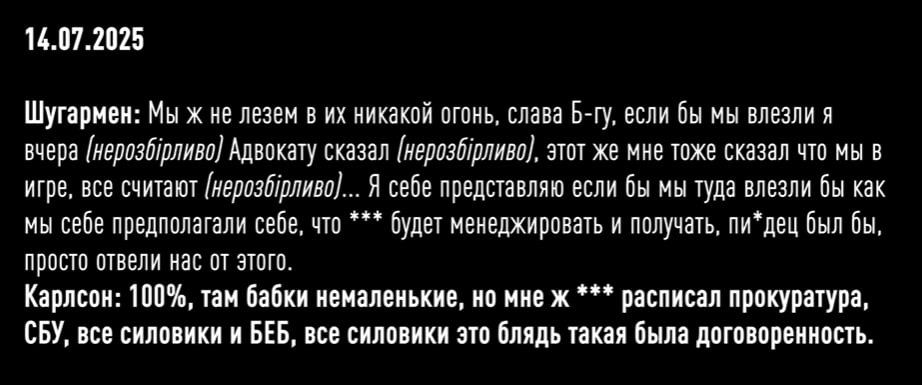
«100%. There is serious money there. But the *** rates were laid out to me by the Office of the Prosecutor General, the SSU, and the ESBU – all the law enforcement agencies. That was the whole *** arrangement.»
The Office of the Prosecutor General’s response was wholly inadequate – no internal investigation was initiated. Its representatives stated that the criminal case information was insufficient to cleanse the system or identify dishonest officials.
7. Prosecutor General’s Office threatens, violates human rights and politically persecutes anti-corruption activists
7.1. On December 12, 2025, Prosecutor General Ruslan Kravchenko, denying media reports that he had submitted his resignation, moved on to openly threaten his critics.
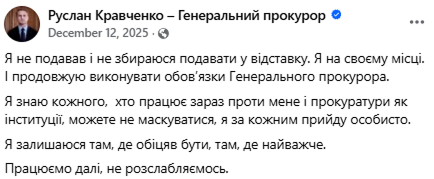
(Ruslan Kravchenko: “I know everyone who is currently working against me and against the Prosecutor’s Office as an institution. You don’t need to hide – I will come for each of you personally.”)
The first open threat since the Revolution of Dignity from a top official toward all of his critics creates a direct threat to members of parliament (in particular, Anastasia Radina and Yaroslav Zhelezniak), civil society representatives (MEZHA, ANTAC, Automaidan, etc.), the NABU and SAPO (in particular, its Leadership Semen Kryvonos and Oleksandr Klymenko), journalists (Ukrainska Pravda, Dzerkalo Tyzhnia, Cenzor.Net, Hromadske, etc.), and constitutes an unacceptable crossing of all red lines.
7.2. The SBI and the Office of the Prosecutor General leaked intimate photos from the phone of Vitaliy Shabunin, Chair of the Board of the Anti-Corruption Action Center, which was confiscated during a search, to anonymous Telegram channels.
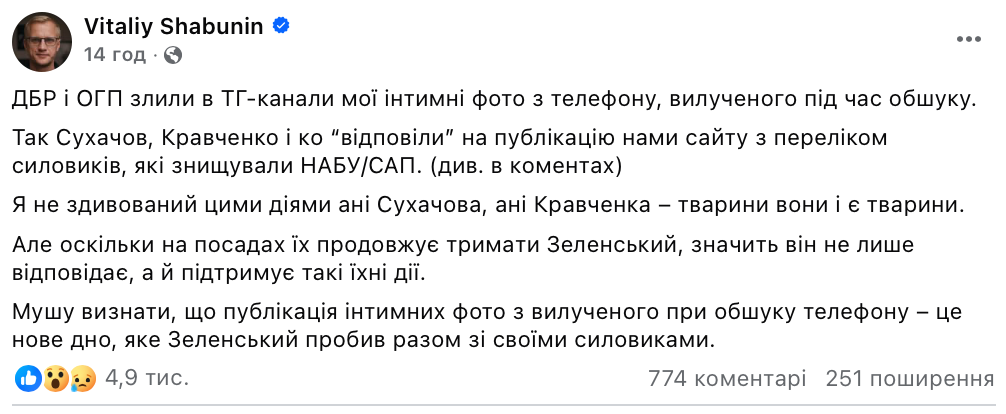
(Vitaliy Shabunin: “The SBI and the Office of the Prosecutor General leaked my intimate photos from my phone, which was confiscated during a search, to Telegram channels.”)
7.3. The Prosecutor General’s Office reopened the case against the Anti-Corruption Action Centre. In March 2016, the Prosecutor General’s Office had already attempted to investigate the organization’s receipt of donor funding from the U.S. government for criminal justice reform. However, the case was closed in May of the same year due to the absence of any evidence of a criminal offence. In March 2026, the Office reopened the proceedings and obtained access to documents held by the U.S. Embassy. These actions appear to be revenge by the Prosecutor General’s Office against AntAC for its continued criticism of the prosecution service’s leadership.
All of these actions and decisions do not correspond to the standards expected of the Prosecutor General as an ethical and professional figure. Therefore, there is an urgent need to appoint a new Prosecutor General through a merit-based process, avoiding nepotism and political loyalty.

