Зміст публікації
22 July 2026
Ukraine’s Mass Protests Intensify Public Scrutiny of the SBI
Executive Summary
For the second week, protests have continued across. Ukraine following the President’s cabinet reshuffle, which resulted in the dismissal of reform-minded Defence Minister Mykhailo Fedorov. In response, military personnel have increasingly spoken out publicly about systemic problems within the. Armed Forces, including military crimes that remain inadequately investigated. Against this backdrop, public scrutiny has also intensified toward the State Bureau of Investigation (SBI), particularly regarding its independence and its ability to investigate senior military officials.
1. SBI Leadership Again Faces Intense Criticism
On the eve of the protests, a court ordered the blocking of the publication of a journalistic investigation into the acquisition of. 143 real estate properties by the SBI Director’s brother at allegedly well below market value. At the same time, Telegram channels linked to the Office of the. President circulated rumors that SBI Director Oleksii Sukhachov could be dismissed during the cabinet reshuffle. These reports appeared intended to increase public acceptance of the broader reshuffle and divert attention from the dismissal of Defence Minister Mykhailo Fedorov.
However, Sukhachov ultimately remained in office, and the protests instead brought renewed public attention to the SBI itself, with demonstrators calling for his resignation.
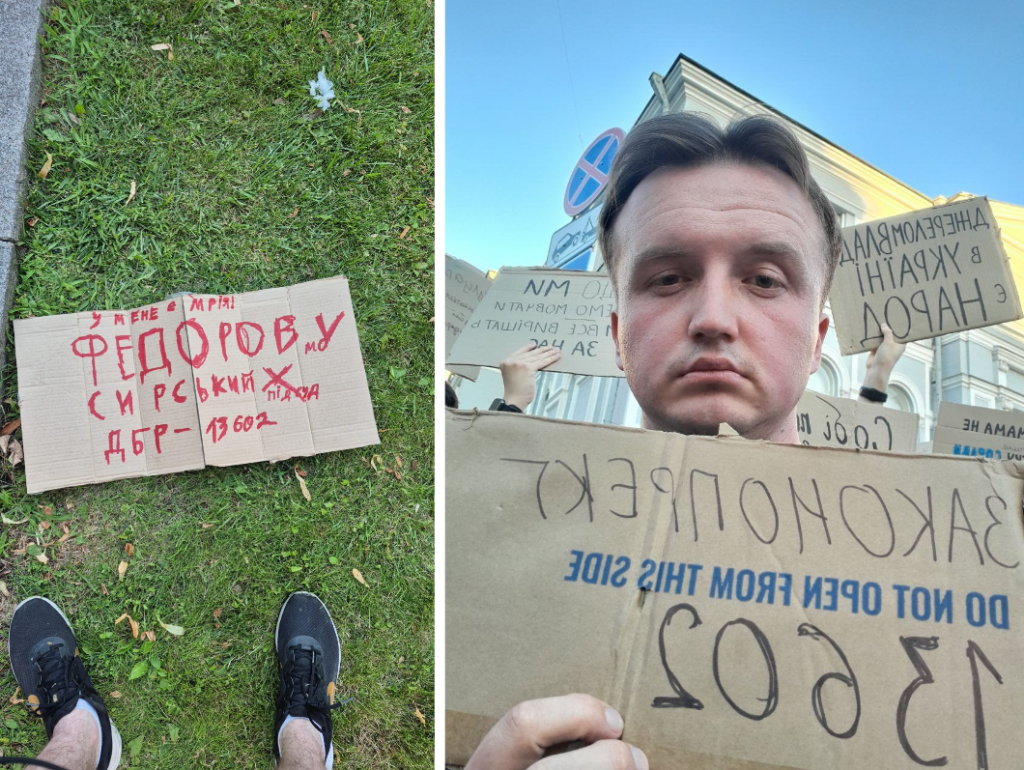
(Protesters’ placards calling for the adoption of Draft Law No. 13602 on the reboot of the SBI)
2. Failure to Ensure Accountability
The political confrontation over Ukraine’s military leadership has renewed questions about accountability for senior commanders. As the authority responsible for investigating offences committed by senior military officials under. Article 216 of the Criminal Procedure Code, the SBI has repeatedly faced criticism not only for the pace of its investigations but also for selective enforcement, procedural shortcomings, and the failure to ensure accountability at the highest levels of military command.
- The SBI and Threats Against Journalists
Journalists from the Ukrainian media outlet Babel exposed allegations of torture, unlawful killings, and other abuses in the Skelia regiment. After one of the regiment’s servicemen publicly threatened a journalist, the SBI publicly stated that criminal proceedings had been registered. However, no criminal proceedings were registered within the 24-hour deadline required by Article 214 of the Criminal Procedure Code.
The discrepancy between the SBI’s public statements and its actions undermined confidence in the. Bureau’s commitment to investigate offences involving military personnel.
2. Lower-Level Commanders as Targets
The SBI’s investigation into the collapse of the defence of. Kharkiv Oblast focused on brigade commanders, while questions concerning the responsibility of senior military leadership remained largely unaddressed. There was no visible scrutiny of higher-level operational planning, force deployment, preparedness, or command decisions that may have contributed to the collapse of the defence. The case became emblematic of criticism that the Bureau pursued accountability primarily at the lower levels of command.
3. Yuriy Sodol Case
Two years after serious public allegations against. Lieutenant General Yurii Sodol prompted calls for a criminal investigation into decisions that allegedly resulted in significant military losses, the. SBI has yet to report any meaningful investigative outcome. The prolonged lack of visible progress has raised concerns about accountability for senior military leadership.
As a result, questions of command responsibility have increasingly shifted from the criminal justice system to the political arena.
3. Political Unwillingness and Institutional Overload
The SBI’s limited record in investigating high-level abuses reflects not only political unwillingness but also increasingly distorted institutional priorities. During the first nine months of 2025, the Bureau registered 161,755 criminal proceedings for unauthorized abandonment of military service and desertion, accounting for approximately 74% of all criminal proceedings completed by the SBI that year.
The Bureau’s own 2025 Annual Report identifies maintaining military discipline as one of its strategic priorities, highlighting joint response mechanisms with military command, legal mechanisms for returning absent soldiers to duty, and the systematic reporting of disciplinary issues to military leadership.
It also reports that prosecutors submitted 9,728 motions to exempt servicemembers from criminal liability after their voluntary return to military service, describing this as a significant contribution to maintaining the size and combat capability of Ukraine’s Defence Forces.
While these objectives may serve an important wartime purpose, they reflect a growing shift away from the SBI’s core mandate. With an authorised staff of approximately 1,900 employees nationwide, the. Bureau is devoting a substantial share of its highly paid investigators to military absenteeism cases and facilitating soldiers’ return to service rather than investigating high-level corruption, abuses of power, and crimes committed by senior officials and military leadership.
4. Absence of Parliamentary Oversight
On 1 July 2026, the Verkhovna Rada Committee on Law Enforcement considered the SBI’s 2025 annual report and declared the. Director’s performance satisfactory without meaningful scrutiny of the Bureau’s political independence, effectiveness, or compliance with its statutory mandate.
The following day, Committee Chair Serhii Ionushas registered Draft Resolution No. 15373 to approve the report and recognise the Director’s performance as satisfactory.
These proceedings demonstrated the absence of effective parliamentary oversight over the SBI.
Conclusion
Without decisive action, the SBI will remain unable to fulfil its statutory mandate as an independent body responsible for investigating high-level corruption and abuses of power. The following measures should therefore be adopted without delay:
- The Verkhovna Rada should recognise the performance of the SBI Director as unsatisfactory, and the President should dismiss the Director pursuant to Article 10(5) of the Law of Ukraine “On the State Bureau of Investigation”, given his failure to ensure that the Bureau effectively fulfils its statutory mandate.
- The Verkhovna Rada should adopt Draft Law No. 13602, submitted by Members of Parliament Yaroslav Zhelezniak and Anastasiia Radina, which introduces a transparent, merit-based procedure for selecting the SBI Director with meaningful involvement of international experts, in line with the European Union benchmarks.
- Following the adoption of Draft Law No. 13602, Ukraine should appoint a new SBI Director through this transparent and independent selection procedure.
- Ukraine should strengthen its military justice system so that the SBI can refocus on its core mandate of investigating high-level corruption and abuses of power.